
у моей витиеватости не такие глубокие корни.. но мы прорвёмся.. пасип, сонцOriginally Posted by mineral


 Re: Звиздужин...
у моей витиеватости не такие глубокие корни.. но мы прорвёмся.. пасип, сонц
 Re: Звиздужин...
Солнце встало, день пришел
Задышали небеса
Запылился старый трон
Мне прикольно, тру-ля-ля....
Re: Звиздужин...
Сони сакс! Сони сакс! Сони сакс!
Re: Звиздужин...
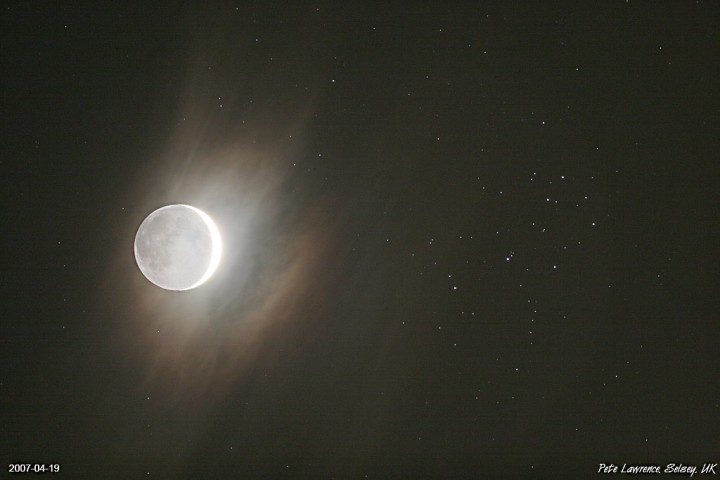
Луна и Плеяды!
Re: Звиздужин...
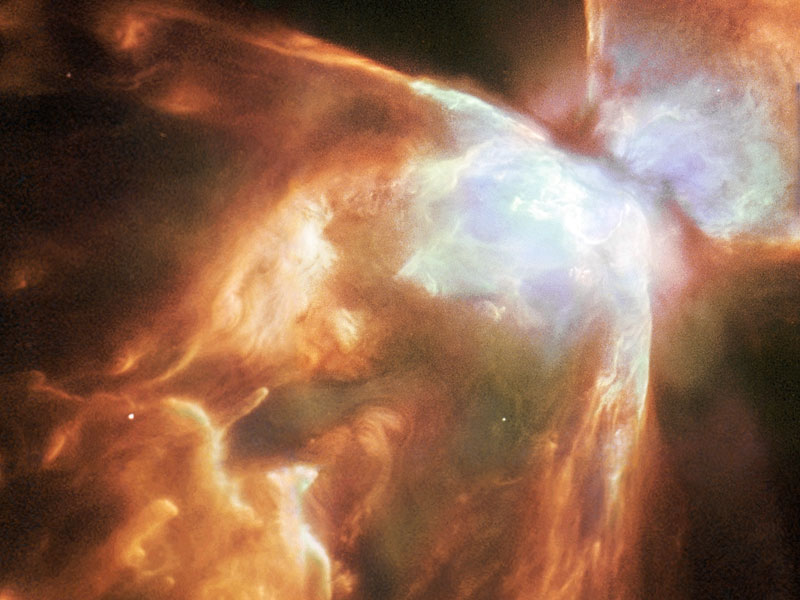
Туманностные часы:
Explanation: The bright clusters and nebulae of planet Earth's night sky are often named for flowers or insects, and NGC 6302 is no exception. With an estimated surface temperature of about 250,000 degrees C, the central star of this particular planetary nebula is exceptionally hot though -- shining brightly in ultraviolet light but hidden from direct view by a dense torus of dust. Above is a dramatically detailed close-up of the dying star's nebula recorded by the Hubble Space Telescope. Cutting across a bright cavity of ionized gas, the dust torus surrounding the central star is in the upper right corner of this view, nearly edge-on to the line-of-sight. Molecular hydrogen has recently been detected in this hot star's dusty cosmic shroud. NGC 6302 lies about 4,000 light-years away in the arachnologically correct constellation Scorpius.
Re: Звиздужин...
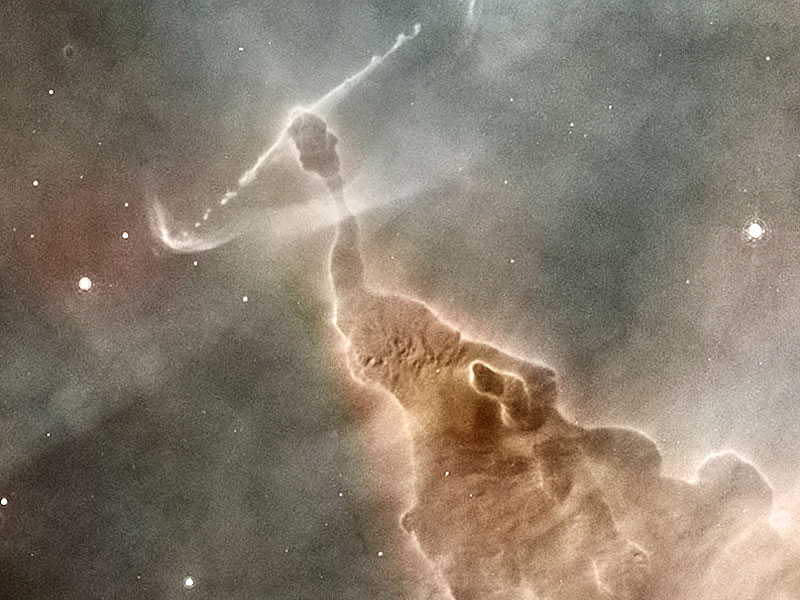
Космический лох Несс:
Explanation: Inside the head of this interstellar monster is a star that is slowly destroying it. The monster, actually an inanimate pillar of gas and dust, measures over a light year in length. The star, not itself visible through the opaque dust, is bursting out partly by ejecting energetic beams of particles. Similar epic battles are being waged all over the star-forming Carina Nebula. The stars will win in the end, destroying their pillars of creation over the next 100,000 years, and resulting in a new open cluster of stars. The pink dots are newly formed stars that have already been freed from their birth monster. The above image is only a small part of a highly detailed panoramic mosaic of the Carina Nebula taken by the Hubble Space Telescope and released last week. The technical name for the stellar jets are Herbig-Haro objects. How a star creates Herbig-Haro jets is an ongoing topic of research, but it likely involves an accretion disk swirling around a central star. A second impressive Herbig-Haro jet is visible across the bottom of a larger image.
Re: Звиздужин...
фЭноменально!
двугорбый псоидный слоник, вытянувшись по-швам, раскручивает на хоботе межгалактический обруч.. триллер "тайна третьего обруча"..
Re: Звиздужин...
ути-пути.. Канон фьють!
Re: Звиздужин...
Цего-цего? Дзевоцка, у дзебя молоцные зуппки?
Re: Звиздужин...
Звизда Фотографьевна Молекулярова... О!
There are currently 1 users browsing this thread. (0 members and 1 guests)
 Posting Permissions

|
Terms of Service | Privacy Policy |
 
|


